Organization Guides
How to Organize a Bathroom Vanity

A bathroom vanity is asked to hold a surprising amount within a relatively small space.
The things used at the beginning and end of each day—skincare, grooming essentials, makeup, towels, soaps, and countless smaller items—often gather in the same few drawers, cabinets, and inches of countertop.
When everything is given equal space, very little remains easy to find.
A well-organized vanity works differently. What is used often remains close at hand. What belongs together stays together. And the countertop is allowed to remain calm rather than becoming another place to store everything that does not yet have a home.
The first step is not adding storage. It is deciding what deserves the space.
Begin With What You Actually Use
Empty the vanity before reorganizing it.
Take items out of the drawers, cabinets, and countertop area so the entire collection can be seen together. This makes it much easier to notice duplicates, products that have been forgotten, and things occupying valuable space despite rarely being used.
Set aside items that are expired, empty, damaged, or no longer useful.
Then look at what is left.
A vanity should primarily serve the routines that actually take place there.

Group the Vanity Around Your Routine
Before deciding where anything belongs, divide the remaining items into useful groups.
Those might include:
- daily skincare
- dental care
- makeup
- hair accessories
- grooming
- jewelry
- soaps and lotions
- extra toiletries
- towels and linens
The exact categories matter less than their usefulness.
Two products used together every morning may have more reason to live together than two products that simply happen to be the same size.
Organization becomes easier when it follows the routine rather than fighting it.
Give the Countertop a Higher Standard
The countertop is usually the most visible part of the vanity.
It should therefore have the fewest things on it.
That does not mean it must remain completely empty. A soap dispenser, a small group of daily skincare products, or another frequently used essential may deserve to remain within reach.
But the countertop should not become overflow storage for everything else.
A simple rule helps:
If something is not used regularly, ask why it needs to live on the counter.
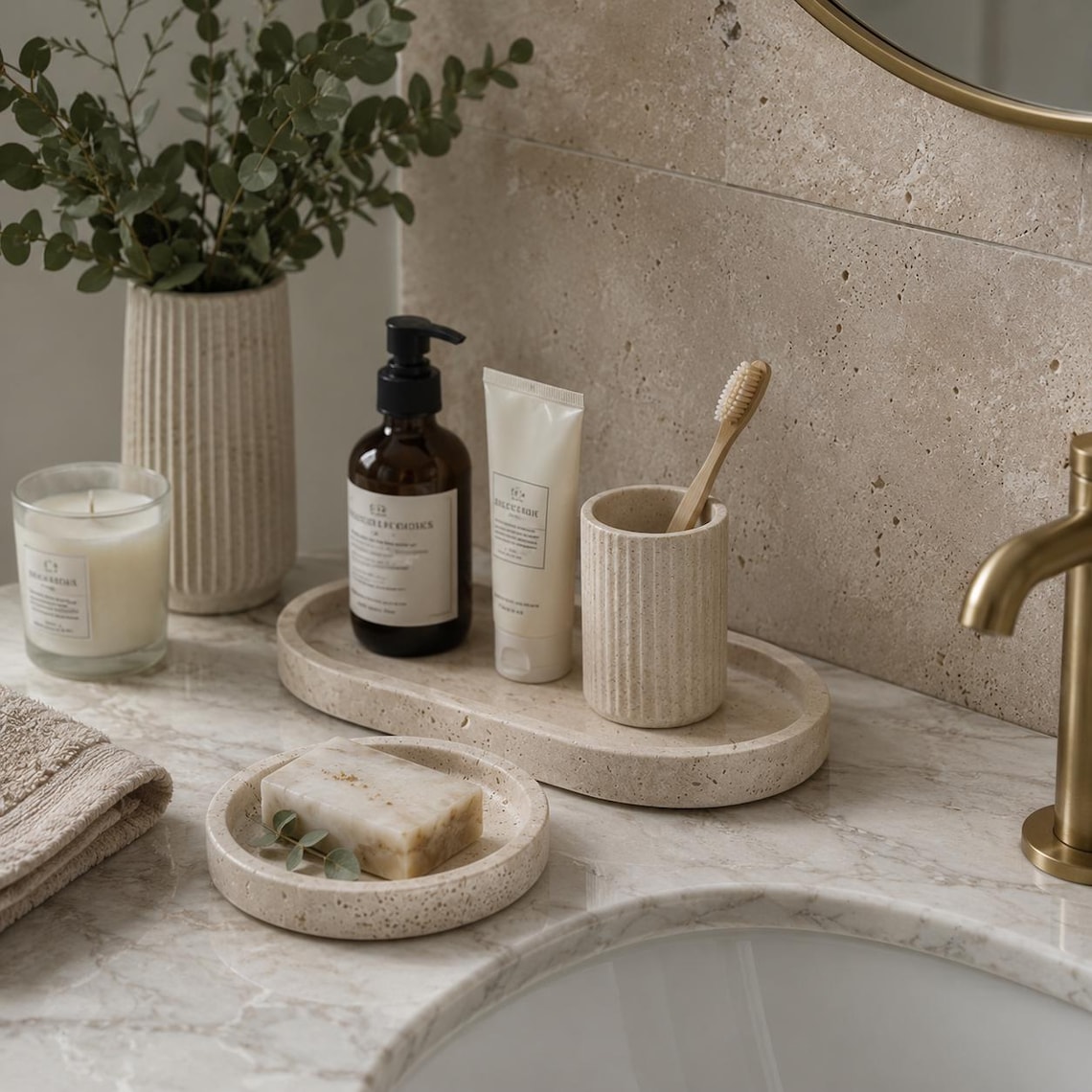
Use a Tray to Create One Defined Place
A few necessary objects can still look scattered when each occupies its own place across the countertop.
A tray changes that relationship.
Instead of several unrelated objects, the eye sees one defined area containing a small collection of things.
That makes a vanity tray particularly useful for a restrained group of everyday items: perhaps perfume, skincare, jewelry, soap, or another small part of the daily routine.
The tray should not become permission to keep everything visible.
Containment works best when it is selective.
Divide Drawers According to What They Hold
A drawer without divisions tends to become one large category called bathroom things.
Small objects move when the drawer opens. Different products overlap. The item needed most seems to settle underneath everything else.
Dividers or individual organizer trays can give those smaller groups defined boundaries.
A makeup drawer, for example, might separate:
- brushes
- lip products
- eye products
- frequently used cosmetics
- small tools
A grooming drawer might need entirely different divisions.
There is no reason every compartment needs to be the same size.
The objects should determine the divisions.
Measure the Drawers Before Choosing Organizers
The principle we established in the pantry applies here as well:
Measure first.
A collection of beautiful organizers does little good if several inches of every drawer become unusable because the pieces do not fit.
Measure the interior width, depth, and height. Then look at the objects that need to be contained.
A combination of different organizer sizes can often use a drawer more intelligently than one rigid insert.
The goal is not to fill every square inch with plastic.
The goal is to give small things boundaries that make sense.
Keep Daily Things Closest
Once the categories are established, decide which ones deserve the easiest access.
The toothbrush used every morning should not compete for space with an unopened refill.
Daily skincare should not need to be moved around a collection of products used twice a year.
Think of the vanity in layers:
Daily use
Keep these easiest to reach.
Regular use
Give these accessible drawer or cabinet space.
Occasional use
These can occupy less convenient areas.
Backstock
Keep extras together rather than mixing them with the products currently in use.
This hierarchy makes the vanity easier to navigate because the most valuable space is reserved for the most valuable routine.
Let Cabinets Handle What the Counter Shouldn't
A vanity cabinet can hold more than a countertop, but that does not mean it should become an unstructured storage box.
Group taller bottles together. Keep refills contained. Separate unrelated categories. In deeper cabinets, consider whether the items at the back can actually be reached without removing everything in front of them.
Again, the architecture of the space should determine the system.
Not every vanity needs the same solution.
Keep Refills Separate From Open Product![]()

Extra toothpaste, soap, skincare, and other toiletries can quietly take over a vanity when each refill is placed beside the item currently being used.
Give backstock its own defined area.
This accomplishes two things.
First, the daily-use areas remain simpler.
Second, it becomes easier to see how much extra inventory is actually in the home before buying more.
A refill should wait for its turn rather than competing with the product it is meant to replace.
Avoid Organizing Things That Should Leave
Containers can make clutter look orderly without actually reducing it.
That is why decluttering comes first.
If a product has not been used in a long time, moving it from the countertop into a beautiful organizer does not necessarily solve anything. It may simply give an unwanted object a more permanent place.
Organization should clarify what belongs.
It should not make it easier to keep everything.
Make the System Easy to Reset
A bathroom vanity is used too frequently to remain untouched.
Products will move. A drawer will occasionally become untidy. Something new will enter the routine.
A lasting system makes those small disruptions easy to correct.
When each category has a recognizable place, resetting the vanity should take minutes rather than requiring another complete organization project.
Every so often:
- return misplaced items;
- remove empty containers;
- wipe organizers and trays;
- move refills forward when needed;
- check for products that are no longer used;
- reconsider any area that repeatedly becomes cluttered.
If one part of the vanity constantly falls apart, change the system.
A useful system should accommodate the home—not require the home to accommodate it.
A Vanity With a Purpose
The best-organized bathroom vanity is not necessarily the one with the fewest objects.
It is the one in which the objects that remain have a reason to be there.
Keep everyday things close. Give smaller items boundaries inside drawers. Allow cabinets to hold what does not need to remain visible. Use the countertop deliberately, and let a tray contain a considered group rather than becoming another place to collect clutter.
When each part of the vanity has a purpose, the room becomes quieter to use.
Order is most valuable when it makes an everyday routine feel simple.